Research Behind the Engineering
Explore six selected studies examining material behavior, structural performance, railway applications, pavement reinforcement and field validation.
Neoloy® Tough-Cells are supported by laboratory research, full-scale testing, numerical modeling and field validation. This work defines how NPA properties and cellular confinement contribute to structural performance and PRS design methods.
Neoloy® Tough-Cells are evaluated through multiple testing methods to understand material behavior, structural response, field performance and quality control under real engineering conditions.
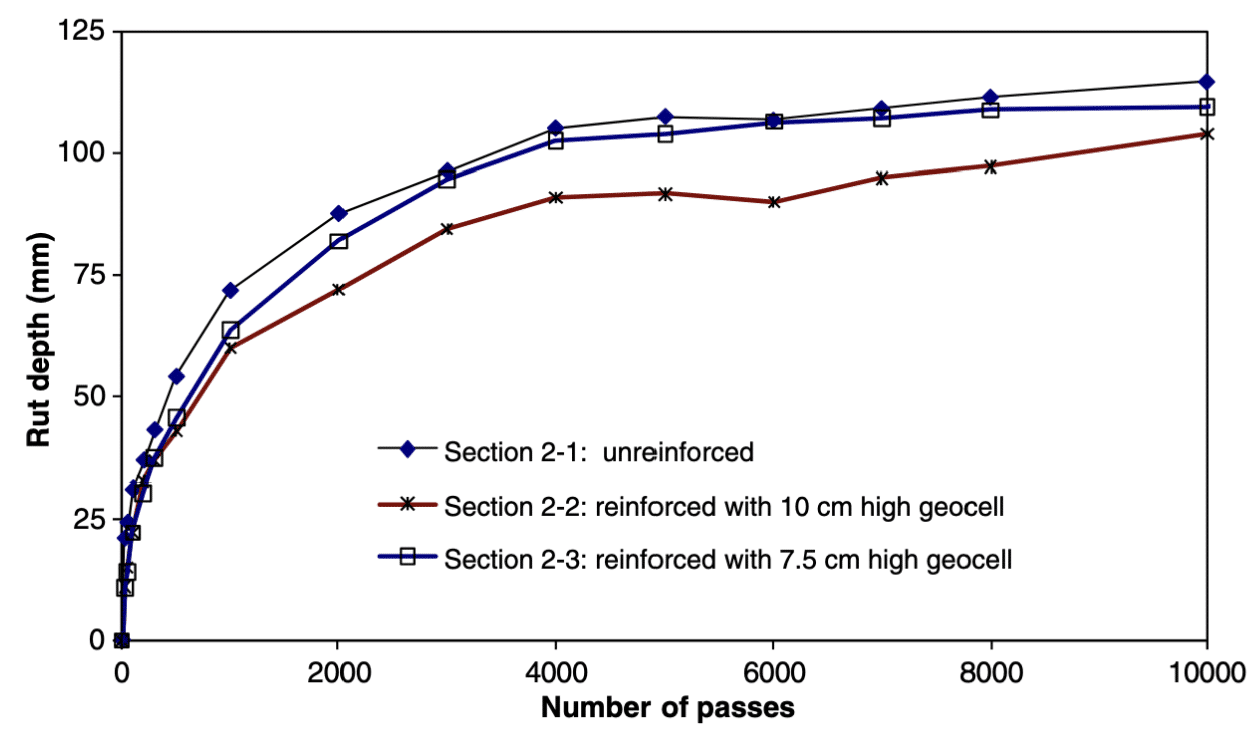
Full-scale accelerated pavement testing evaluates how reinforced pavement sections respond to repeated wheel loading under controlled traffic conditions. Published testing compared NPA-reinforced and unreinforced recycled asphalt pavement over weak subgrade, measuring rutting, deformation and load distribution.For the comparable FRAP sections, the same 25 cm total base thickness was used with consistent compaction. The NPA-reinforced sections developed less rutting and sustained more wheel passes before reaching the same rut-depth level.
PUBLISHED TEST FIGURE
Fig. 8 – Rut depth vs. number of wheel passes for FRAP sections.
Evidence source: Han et al. (2011), Performance of Geocell-Reinforced RAP Bases over Weak Subgrade under Full-Scale Moving Wheel Loads. Read more
ACCELERATED PAVEMENT TESTING AT KANSAS STATE UNIVERSITY.
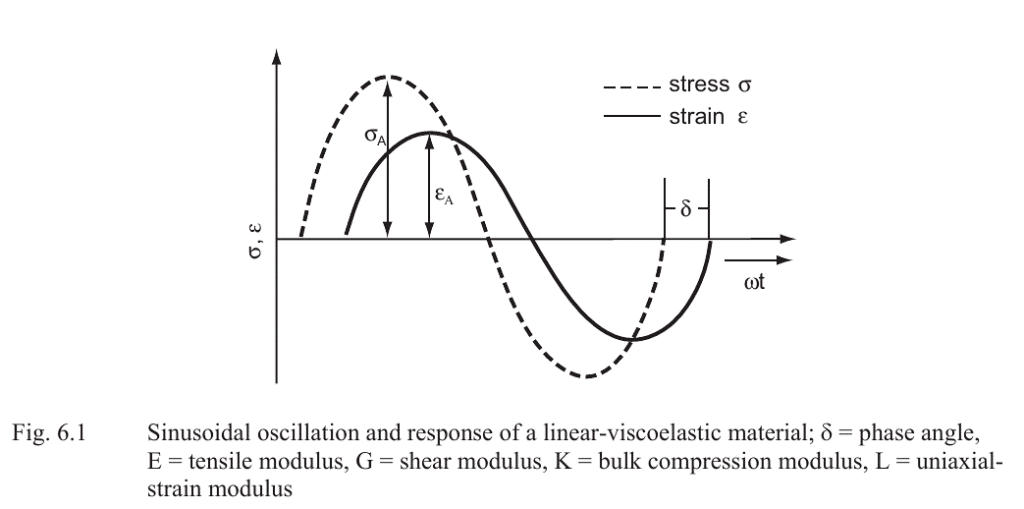
Dynamic Mechanical Analysis (DMA) shows how a material responds to repeated, small oscillating loads as temperature and time change. It measures the relationship between applied stress and the resulting deformation.
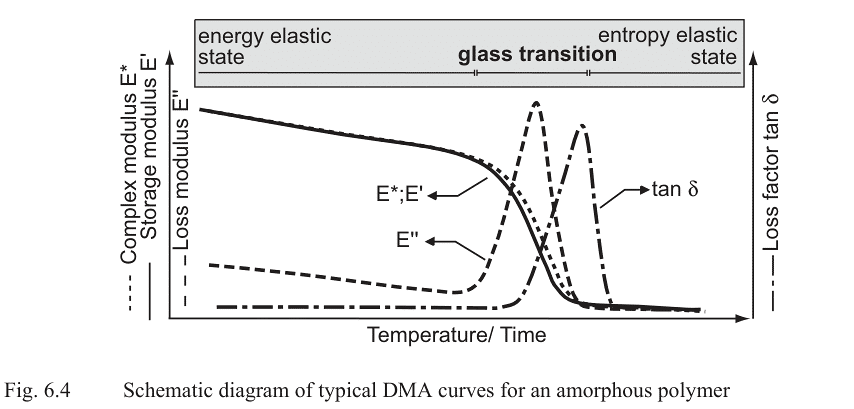
The test helps engineers understand three key parts of material behavior: elastic stiffness, energy loss and damping. These properties help show how a polymer behaves under changing service conditions
DMA principle — an oscillating stress is applied and the material’s strain response and phase shift are measured.
Source: Dynamic Mechanical Analysis (DMA), Chapter 6.
Typical DMA response showing how storage modulus, loss modulus and damping change with temperature.
Source: Dynamic Mechanical Analysis (DMA), Chapter 6.
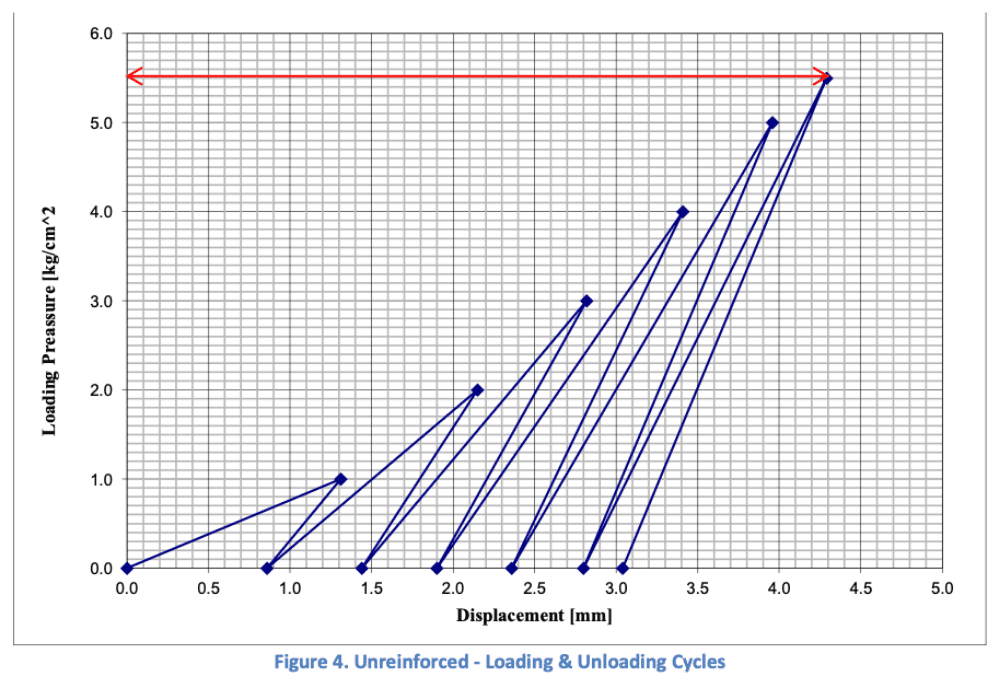
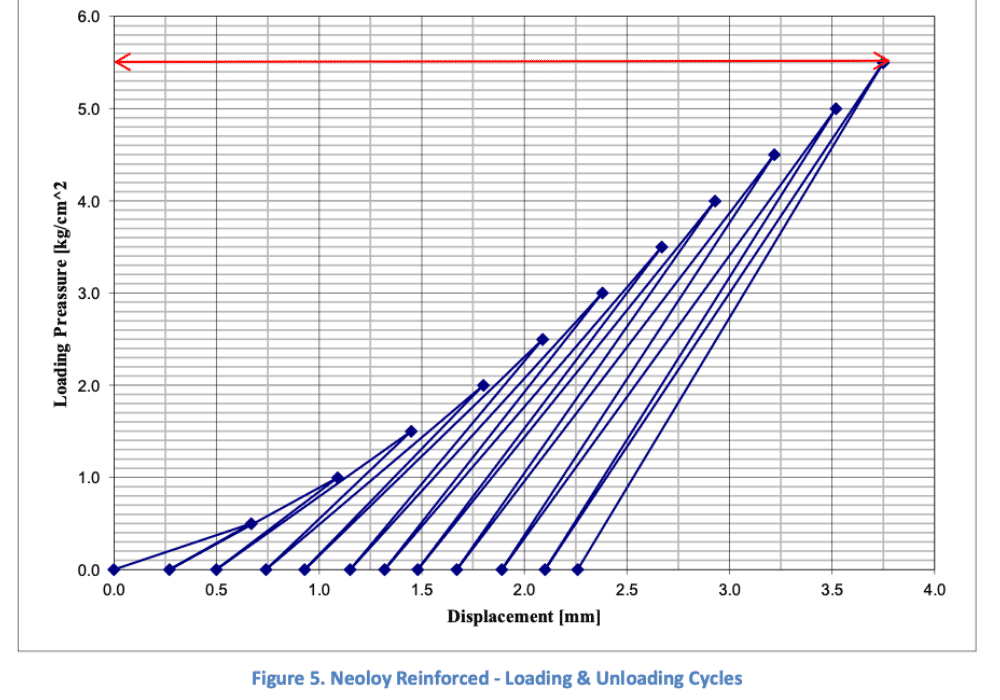
Static plate load testing is used on site to check how a pavement layer responds to load and to compare a Neoloy® Tough-Cells reinforced section with an unreinforced control section. A vertical load is applied through a rigid plate while the resulting surface movement is measured.
The results are used to determine pavement stiffness and the in-situ Modulus Improvement Factor (MIF). Where pressure cells are installed, stresses below the reinforced and control sections can also be compared.
The test provides a practical field check that the constructed layer is performing as intended. Results are reviewed together with compaction, moisture and material-quality data — the plate load result is not used alone to approve the layer.
Unreinforced control chart
Loading and unloading response of the unreinforced control section during static plate load testing.
Neoloy® reinforced chart
Loading and unloading response of the Neoloy® Tough-Cells reinforced section during static plate load testing.
Source: Static Plate Load Test Procedures, Rev. 2023.1
Static plate load testing in the field to measure the response of a Neoloy® Tough-Cells reinforced pavement layer.
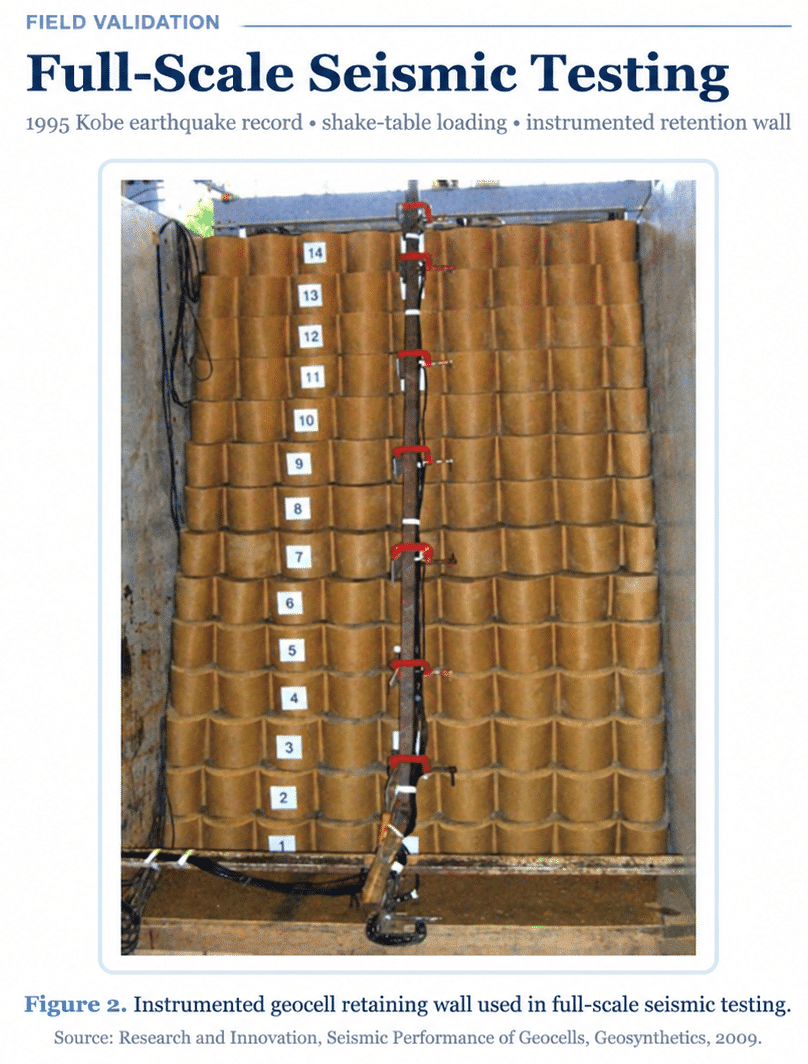
Large-scale shake-table testing examined how geocell retaining and reinforced slope systems behave during strong earthquake loading. Five test structures were subjected to ground motion based on the 1995 Kobe earthquake and then examined for deformation and the development of slip surfaces.
The tests showed that the flexible systems could deform and dissipate energy while maintaining the overall structure. Under the tested conditions, the study reported upper-bound equivalent seismic coefficients of approximately 0.4 × PGA for gravity-wall configurations and 0.3 × PGA for reinforced geocell systems.
The research helps engineers understand how flexible cellular confinement systems respond under severe seismic loading and how this behavior can be considered in seismic stability analysis.
Published studies and field research have examined how NPA-based cellular confinement influences stiffness, deformation, load distribution and long-term infrastructure performance. The studies below represent a selected sample of this research — not the complete body of work.
Explore six selected studies examining material behavior, structural performance, railway applications, pavement reinforcement and field validation.
Laboratory testing compared unreinforced RAP with RAP confined by NPA material under sustained loading at 25°C. The study measured initial deformation and how deformation continued to develop over time.
Recycled materials can provide structural value, but their long-term deformation must be controlled. The research showed how cellular confinement can help improve the stability of RAP under sustained load.
NPA confinement significantly reduced both initial deformation and the rate of creep under the tested conditions.
View Research →Laboratory testing, field data and pavement analysis were used to quantify the structural contribution of NPA reinforcement through the Modulus Improvement Factor (MIF).
MIF provides a practical link between measured improvement and pavement design, helping engineers account for the reinforced layer when optimizing pavement structures.
The Highway 6 demonstration design used an equivalent MIF of 2.54 for the full reinforced base.
View Research →Large-scale laboratory testing using NPA confinement was combined with validated 3D finite-element modeling to study railway ballast under different foundation and ballast conditions.
The research helps explain how confinement limits ballast movement and distributes loads more evenly, particularly where railway foundations are weak or ballast quality is reduced.
In the modeled railway configuration, confinement substantially reduced lateral movement and improved stress distribution.
View Research →The study examined a railway system combining a stiff biaxial geogrid at the subgrade with NPA reinforcement within the granular layer above expansive clay.
Expansive soils can cause uneven movement and recurring track maintenance. The hybrid system was developed to reduce differential heave and improve track stability.
Field experience supported continued use of the hybrid solution for problematic expansive-soil conditions.
View Research →An instrumented field study compared reinforced and control sections on Amtrak’s Northeast Corridor under high-speed and regional passenger traffic.
The project moved beyond laboratory testing by measuring pressure and track geometry under operating railway conditions.
Four heavy-traffic road projects in Alberta evaluated the use of Neoloy® reinforcement to reduce aggregate demand, haulage and dependence on imported construction materials.
The case studies demonstrate how structural reinforcement can support greater use of local materials while reducing material transport and associated environmental impact.
See what engineers, project teams and independent industry publications say about Neoloy® Tough-Cells through real project experience, professional perspectives and media coverage.
“The performance of the Route Trident with Neoloy reinforcement exceeded all expectations.”
“The PRS-Neoloy reinforcement proved to be effective in reducing degradation, showing a reduction in the surfacing maintenance cycle on the order of seven times.”
“The PRS-Neoloy was the only qualified solution that not only met, but exceeded, all our project requirements.”
“The initial results indicate a stabilization of the settlements and an adequate distribution of the angular distortions, thanks to the high stiffness of the Neoloy 12 cm height cells.”
“Fast delivery. Excellent technical support – on-site training. Responsive and professional service.”
“The Neoloy system made it possible to make a rigid structure resistant to deformations with a high load-bearing modulus.”
“We were satisfied with the technical assistance from PRS Poland and would recommend PRS Neoloy in other geo-technically challenging projects.”
“We are confident that other organizations seeking similar solutions will find PRS Neoloy Tough-Cells an invaluable asset.”
“We highly value the cooperation and engineering expertise demonstrated by PRS and we are pleased to recommend the use of Neoloy Tough-Cells in future railway and roads projects.”
“From a professional civil engineering point of view I strongly recommend the use of Neoloy for ground improvement and road reinforcement projects.”
“The NPA solution has proven itself from both economic and engineering perspectives, especially in applications subject to heavy loads.”
“The PRS-Neoloy-356-200 product performed well as part of these experiments. The product was purchased directly from the manufacturer and delivered in a timely manner.”
“The cell walls of the Neoloy completely encase the infill material and provide an all-around confinement to the soil.”
Skanska reported that the Neoloy system met the project’s technical requirements, with straightforward installation, reduced road-construction costs and a relatively short installation time.
Neoloy® projects, field applications and supporting research have been featured in engineering and infrastructure publications worldwide.
WSP’s account of the rehabilitation and extension of the Rubkona gravel runway in South Sudan, including a value-engineered cellular confinement solution using locally sourced sand.
Estimated construction-cost comparison reported in the article.
Coverage of the Rubkona airfield rehabilitation project in South Sudan in the official magazine of the Institute of Municipal Engineering of Southern Africa.
Independent infrastructure coverage of a major rehabilitation project in South Sudan.
A University of Kansas research overview covering plate-load, cyclic loading and full-scale moving-wheel testing of NPA-reinforced unpaved road sections.
Stiffness, bearing capacity and permanent deformation were among the performance characteristics examined.
An overview of the development of NPA cellular confinement technology, with infrastructure examples including airports, railways and port facilities.
The original article was published in Spanish; this website summary is presented in English.
A case study of the San Martín railway viaduct in Buenos Aires, where Neoloy® reinforcement was incorporated into the embankment foundation system over soft clay.
The original article was published in Spanish; the visitor-facing summary here remains in English.
Coverage of the Hudson Bay Railway repair near Churchill, Manitoba, following flood damage and challenging permafrost conditions.
Repair duration reported in the published case study.
A case study of a compressor-station working platform on soft subgrade in Alberta using a hybrid system combining NPA cellular confinement and biaxial geogrid.
Share your project conditions, performance requirements and design objectives to explore whether Neoloy® Tough-Cells are a suitable solution.