
4 Critical Parameters Behind Neoloy® Tough-Cells Performance
When a geocell is filled and loaded, vertical stresses create lateral pressure on the cell walls. If the material creeps, loses stiffness, tears, or degrades, the system lose confinement and structural contribution.
How Neoloy® Tough-Cells are evaluated for long-term performance
Long-term creep and dimensional stability.
Dynamic stiffness and elastic response.
Tensile capacity of the geocell strip.
Strength of welded seams and connections.
Resistance to oxidation, UV, and thermal effects.
Every Neoloy® Tough-Cell is evaluated to deliver reliable performance in demanding environments.
Resistance to permanent deformation characterizes the material’s susceptibility to creep under sustained load. Creep is time-dependent strain that occurs when a polymer is subjected to constant stress.
In geocells, creep directly affects dimensional stability and the ability to maintain confinement. This behavior is evaluated using the Stepped Isothermal Method (SIM),referenced through ASTM D6992.
Why it matters: excessive creep expand the cell geometry, reduce lateral restraint, and weaken structural interaction with the infill.
The video below shows the SIM test, comparing Neoloy® Tough-Cells based NPA material with standard HDPE geocells under a sustained load of 6.1 kN/m and increasing temperatures from 23°C to 58°C.
The result is clear:
Value: stronger resistance to permanent deformation helps maintain confinement, load transfer, and long-term road performance.
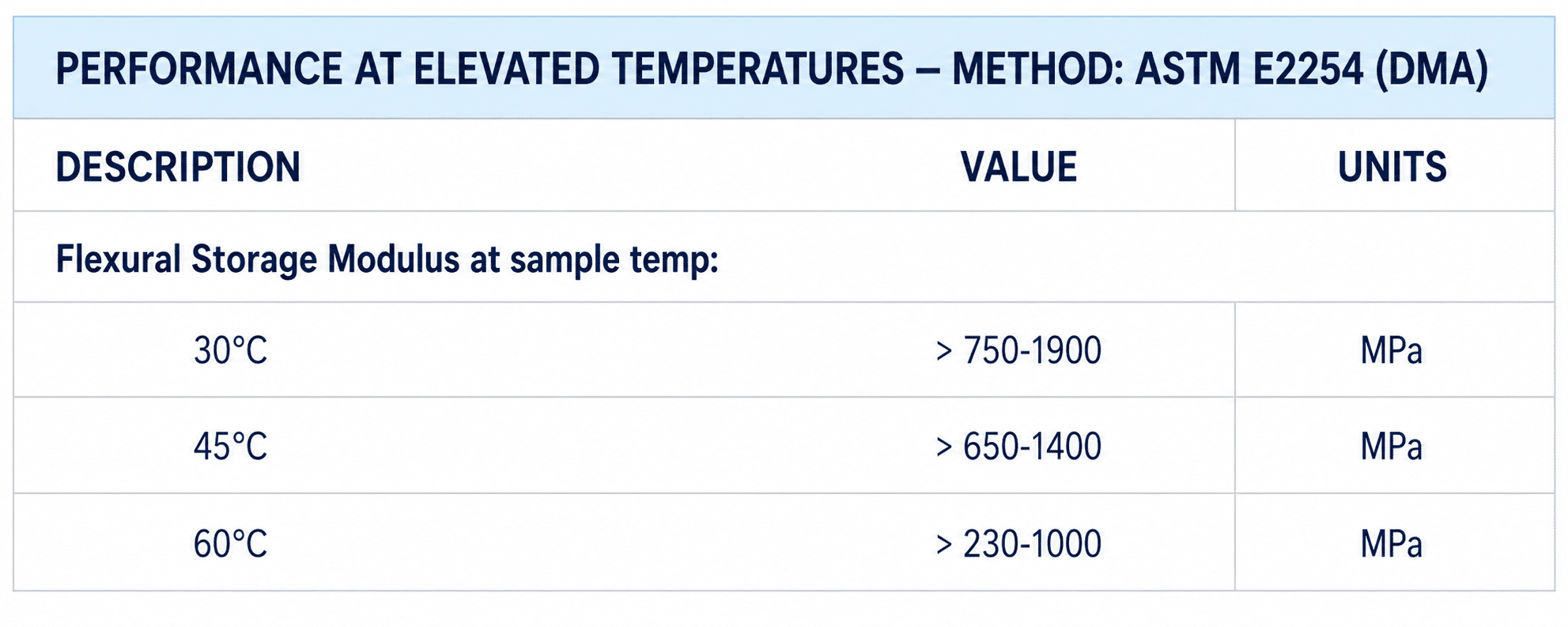
Elastic stiffness defines the material’s ability to resist deformation under load and recover upon unloading. It reflects the modulus under dynamic conditions and the capacity to respond to cyclic loading without accumulating permanent strain.
Elastic stiffness is commonly measured using Dynamic Mechanical Analysis (DMA), referenced through ASTM E2254 which evaluates storage modulus and viscoelastic response across temperatures and loading frequencies.
Why it matters: adequate stiffness maintain confinement, distribute stresses, reduce rutting, and support stable performance under traffic-induced loading.
Tensile Stength represents the tensile capacity of the geocell strip under induced stresses. In service, lateral pressure from confined infill generates hoop stresses within the cell walls.
This property is evaluated through tensile testing, including wide-width methods such as ISO 10319.
Why it matters: the cell wall must resist tensile stresses without rupture or excessive elongation to maintain structural integrity and load transfer.
The video below shows a Wide-Width Tensile Test, used to evaluate the tensile strength of the geocell wall. A Neoloy® strip is clamped into a universal testing machine and pulled under controlled vertical tension until the material reaches its tensile limit.
The tested Neoloy® sample includes standard cell-wall perforations, which makes the result more representative of the product used in real field applications. Perforations reduce the continuous material area of the strip, so tensile results for non-perforated samples are typically higher. Testing the perforated cell wall provides a more practical and conservative indication of in-service performance.
Neoloy® typically withstands 16–22 kN/m of tensile force, demonstrating the strength needed to resist the lateral pressure generated inside the cell under heavy traffic loads. By comparison, conventional HDPE geocells typically withstand 9–12 kN/m.
Value: high tensile strength helps the cell walls resist stretching, rupture, and loss of confinement. This supports stronger load distribution, enabling the use of marginal materials.
Seam weld tensile strength represents the strength of the welded junctions connecting the geocell strips. In service, these seams transfer stresses between adjacent cell walls and help maintain the integrity of the three-dimensional confinement system.
For reliable performance, the seam weld tensile strength should be equal to or higher than the wide-width tensile strength of the geocell wall. If the weld is weaker than the cell wall, the connection can become the critical failure point under load.
This property is evaluated through seam strength testing, including ISO 13426-1.
Why it matters: the welded seams must resist separation, rupture, and excessive deformation under load. Strong seam integrity helps keep the geocell structure connected, stable, and able to transfer stresses across the full cellular confinement system.
The video below shows a Seam Weld Tensile Strength Test, used to evaluate the strength of the welded junctions between cell strips. The test pulls the connected strips in opposite directions to measure how much force the weld can resist before separation or failure.
Neoloy® Tough-Cells typically maintain 16–22 kN/m seam weld strength, even in perforated cell walls, demonstrating that the welded joints can withstand high lateral stresses under load. By comparison, conventional HDPE geocells typically withstand 9–12 kN/m.
Value: seam weld strength is critical as the welds hold the 3D cellular structure together. Strong weld integrity helps prevent cell opening, loss of confinement, rutting, and structural failure under heavy and repeated dynamic loading.
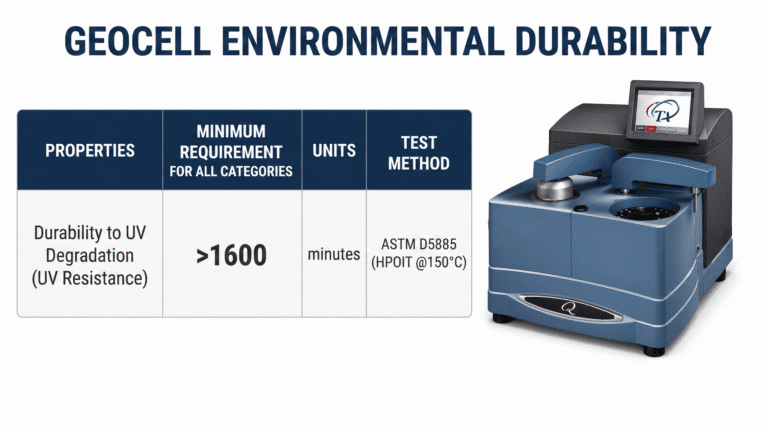
Environmental durability defines the material’s resistance to degradation mechanisms such as oxidation, UV exposure, and thermal effects.
Durability is assessed using methods that evaluate oxidative stability, including High Pressure Oxidative Induction Time (HP-OIT), referenced through ASTM D5885.
Why it matters: material degradation can reduce strength, stiffness, and deformation resistance over time. Durability is essential for long-term infrastructure reliability.
Project conditions vary in loading, subgrade characteristics, environmental exposure, infill availability, and design requirements. PRS applies these engineering parameters to support performance evaluation and product selection.
Neoloy® Tough-Cells are used in applications requiring sustained performance, including roads, railways, ports, airports, mining roads, industrial platforms, weak soil stabilization, and heavy-duty load support.
Need help evaluating performance requirement?
PRS can asses your project conditions and recommend the appropriate Neoloy® Tough-Cells solution.