
For Stronger Soil Stabilization Performance
A cellular confinement system, also know as geocells improves the behavior of soil or infill by holding the material in place and limiting lateral movement. Instead of relying only on the natural strength of the subgrade, the system creates a stabilized layer that can improve load distribution and surface performance.
Cellular confinement systems today are used in roads, railways, ports, airports, slopes, channels, mining roads, industrial platforms, and other infrastructure applications where soil conditions or loading requirements create engineering challenges.
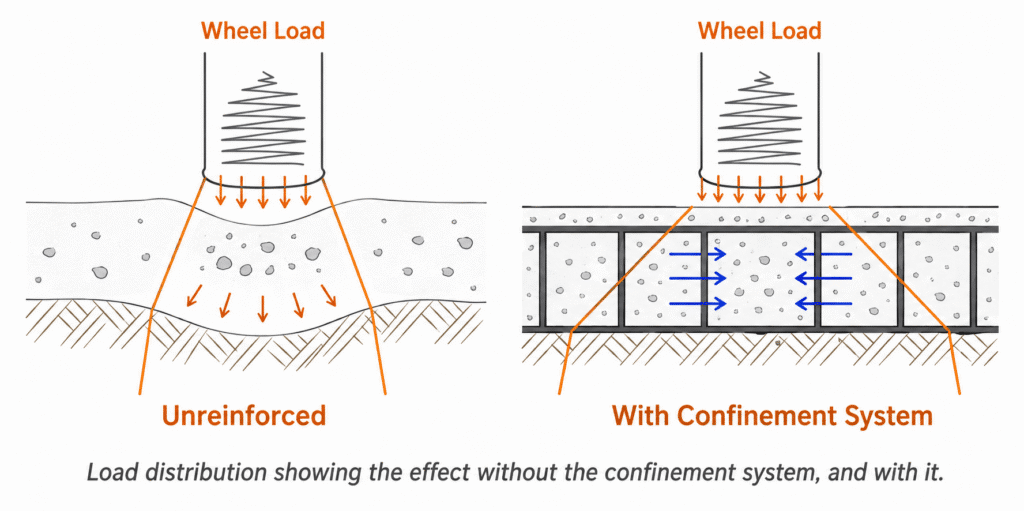
The system works through the interaction between cell geometry, infill material, surrounding soil, and applied loads. When vertical loads are applied, the confined infill pushes laterally against the cell walls. The cell walls resist this movement and help transfer load across a wider area.
This creates a reinforced mattress effect that can reduce stress on weak subgrades, limit rutting, and improve the performance of the pavement or foundation layer.
The 3D structure helps distribute loads more efficiently and reduces stress concentration on weak subgrades.
Improved confinement can support more efficient pavement or foundation designs in suitable applications.
Confinement can improve the performance of locally available, marginal, or recycled materials where approved by design.
Reduced excavation, hauling, and material replacement can help simplify construction in remote or difficult sites.
A better stabilized layer can reduce rutting, settlement, and maintenance needs over time.
The performance of a cellular confinement system depends on both the geometry and the material used to manufacture the cell walls. This is critical because plastics deform under sustained load, temperature changes, and dynamic stress.
If the cell walls lose stiffness or change geometry, the system loses confinement, compaction, and structural contribution. For heavy-duty or long-term infrastructure, geocell material selection should be based on engineering performance, not appearance alone.
The U.S. Army Corps of Engineers developed the first cellular confinement systems (also known as geocells), in the 1970s. The goal was practical: help heavy military vehicles cross soft ground and loose sand without getting stuck.
Early prototypes used simple materials such as wax-coated kraft paper and thin glued aluminum. These trials proved a core engineering principle that still drives the technology today: soil performs better when a three-dimensional structure confines it.
Geocell technology took a step forward in the early 1980s with High-Density Polyethylene (HDPE) for slope protection and erosion control. Manufacturers welded flexible HDPE strips ultrasonically into a honeycomb-like structure. This process created the first widely used plastic cellular confinement systems.
By the 1990s, PRS was already applying HDPE geocells in lower-demand projects. As infrastructure projects grew more demanding, the market recognized the need for a stronger geocell material. The new material had to maintain stiffness, strength, and dimensional stability under sustained loads, temperature changes, and repeated dynamic stress.
PRS joined a dedicated R&D program to meet this challenge. Together with international leading public bodies worldwide, and leading researchers, the R&D developed the Novel Polymeric Alloy (NPA), based on that, PRS developed the Neoloy Tough-Cells based on NPA material. Extensive laboratory and in-situ testing validated the material’s performance.
NPA, used in Neoloy® Tough-Cells, are engineered for demanding infrastructure applications where peformance and durability are required.
HDPE are commonly used for basic soil stabilization, erosion control, moderate slopes, low-load support, and shorter-term applications where performance demands are not required.
Every project has different soil conditions, traffic loads, design-life requirements, material availability, construction constraints, and budget priorities. PRS does not treat geocell technology as a one-size-fits-all product.
Our team supports clients with project evaluation, engineering support, and value engineering to help identify the most suitable cellular confinement solution for each application.
PRS can evaluate your site conditions, application requirements, and performance goals to recommend the most suitable cellular confinement system.