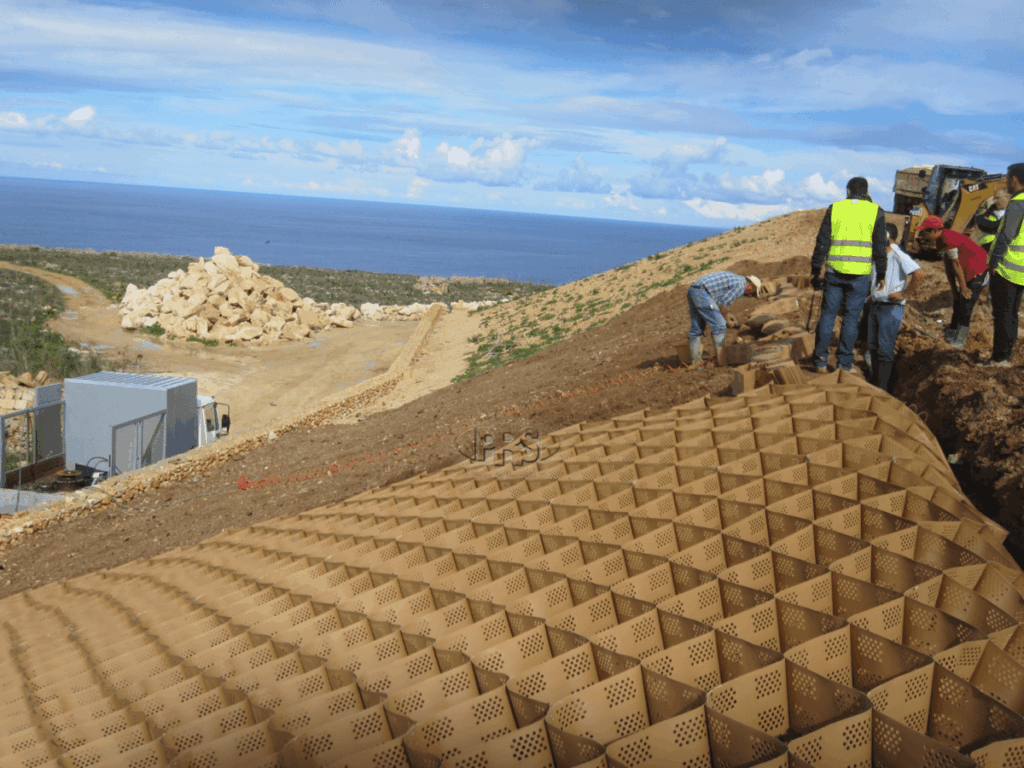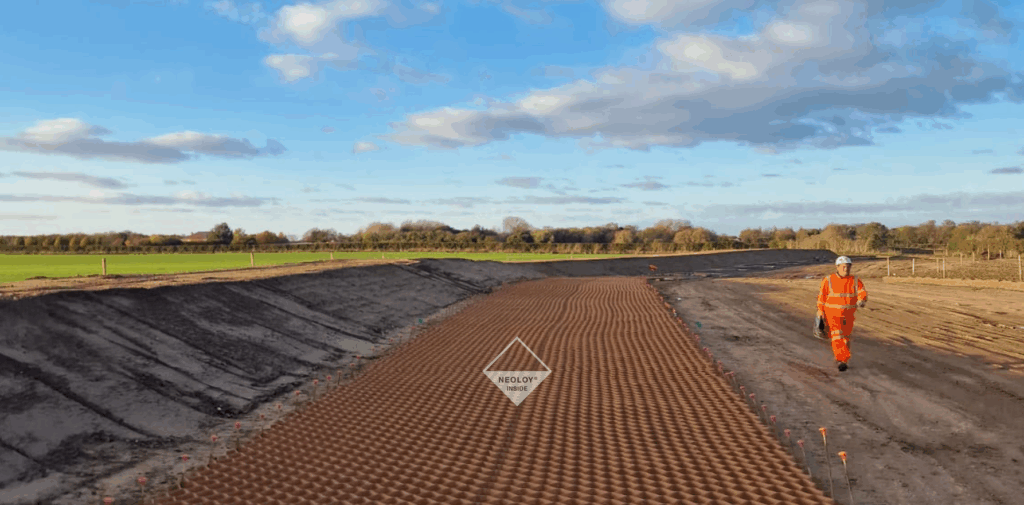
Strabag achieved 3 key construction goals using Neoloy Tough Cells – a sustainable solution using recycled materials, high reinforcement factor and significant cost savings.
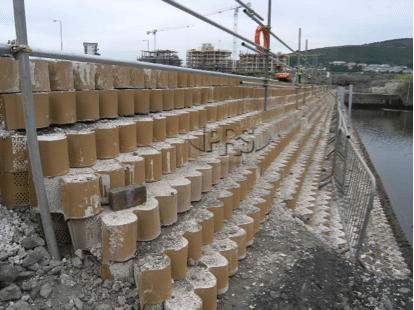
To meet the challenges of rebuilding and expanding the Oliwskie Quay at Gdansk port, Strabag chose Neoloy technology, in line with their core values of innovation, sustainability, quality and economy. Neoloy Tough Cells are a unique reinforcement geosynthetic, as their high elastic stiffness, tensile strength and low permanent deformation properties were designed to meet the needs of long term, heavy-duty infrastructure projects, such as this one.
Neoloy Tough Cells stabilize and reinforce soil even in the soft, saturated marine conditions at Gdansk to provide a strong foundation for the heavy-duty loads – from the port cranes as well as the weight of the railway. Neoloy 3D confinement also increases the strength of marginal materials, thereby enabling the recycling of onsite sand and crushed concrete for structural infill. The result is higher performance at a lower price.
PRS Neoloy Tough Cells reinforced port pavement in the challenging port environment attests to Neoloy’s high engineering, environmental and economic value.
CONVENTIONAL SOLUTION
Strong effective subgrade stabilization was required for this pavement. A 55 cm subbase of 3 layers of rigid geogrids with crushed stone was considered, but not only did it require large quantities of expensive aggregate. – it did not achieve the required reinforcement strength. The conventional solution also necessitated 50 cm subgrade soil replacement.
Strabag chose Neoloy due to its high modulus improvement factor (in this case from 20 MPa to 160 MP); as well as Neoloy’s ability to use readily available sand and crushed concrete from the old pavement and long-term
performance characteristics: low permanent deformation <3% at 75 years; high tensile strength >19 kN/m perforated; high dynamic (elastic) stiffness >525MPa @60°C. Neoloy provides wide load distribution with very low differential settlement for both static loads (pavement weight) and dynamic loads (crane operations).
The quay pavement consisted of the section with Neoloy Tough Cells reinforcement for vehicular and railway traffic, and a special concrete design structure for the crane tracks. Construction was phased along the quay to
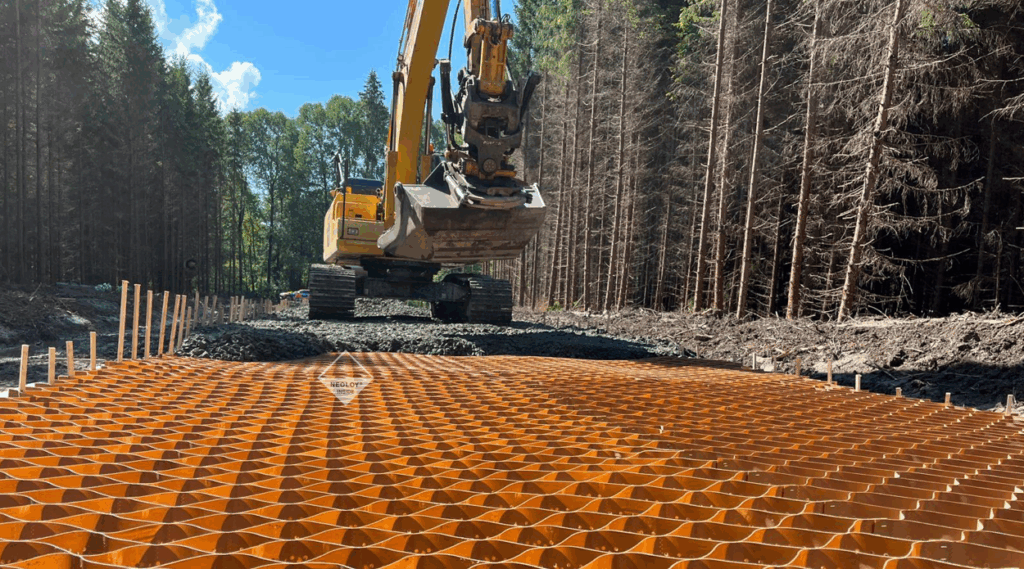
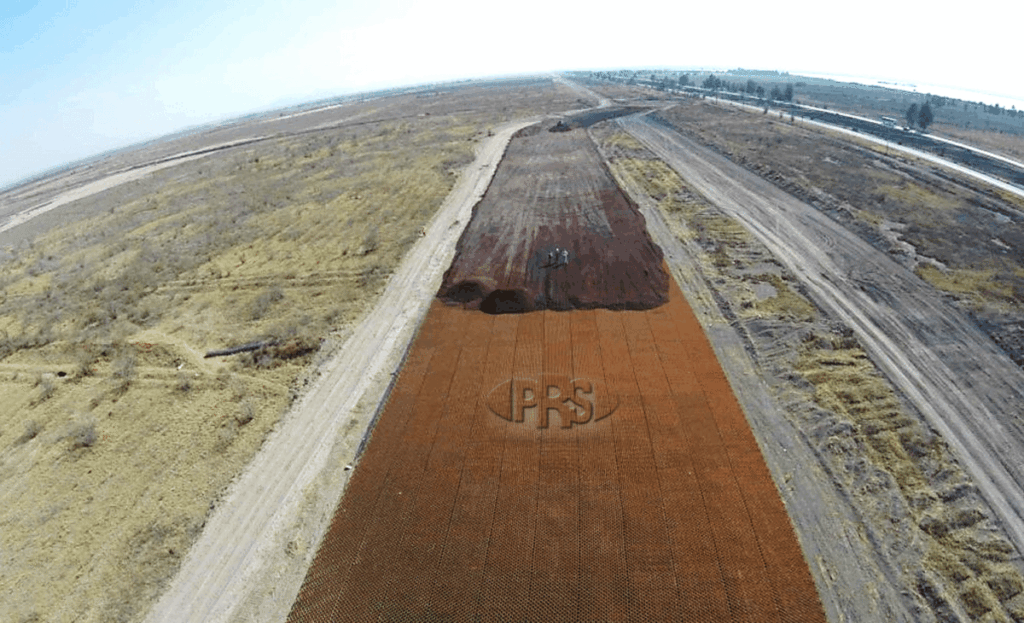
enable port operations to continue with as little downtime as possible. After removing the old pavement structure, PRS-330 Neoloy (15 cm height) was placed on the capping layer. Recovered dredged sand was used for infill. Recycled (onsite) crushed concrete was used to complete the subbase layer. The base was C30/37 class concrete and the surface C35/45 class reinforced concrete.

Application
Port Pavement
Subgrade/Soil
Unconsolidated saturated soil
Region
Baltic Sea
Installation
2020
Client
STRABAG SE is a European-based technology partner for construction services, a leader in innovation and financial strength. Strabag services span all areas of the construction industry and cover the entire construction value chain. Strabag brings together people, materials and machinery at the right place and at the right time in order to realize even complex construction projects – on schedule, of the highest quality and at the best price.
ABOUT PRS
PRS Geo Technologies (www.prs med.com) is a global engineering, manufacturing and technology company providing the unique PRS Neoloy Tough Cells 3D mechanical soil stabilization technology. Since its
establishment in 1996, PRS has implemented thousands of successful projects in over 80 countries worldwide.