
UK Flood Risks and Infrastructure Challenges
The risks posed by flooding to the UK’s infrastructure are considerable.
It has been established that in England alone, 6.3 million properties are at risk of flooding, with surface water flooding putting 4.6 million of this number in jeopardy.
There is further cause for concern in that 38% of the country’s roads currently lie in flood-risk zones.
In the event of already ageing road, rail and port infrastructure becoming submerged in surface and river water, the knock-on effect would be catastrophic.
Operational downtime in businesses, widespread damage and skyrocketing maintenance costs would effectively become the new normal.
Challenges Faced by UK Businesses
Disaster-level flooding inevitably impacts business infrastructure crucial to free-flowing supply chains.
Already 4,300km of the UK’s rail network occurs in flood-risk zones and coastal erosion is threatening industrial and port areas, according to the British government.
The soil instability resulting from flooding proves highly detrimental to industrial sites, logistics hubs and energy access roads in instances where they need to be rebuilt.
In addition, aside from the inability to operate, insurance and maintenance expenses put businesses and municipalities under huge financial pressure.
Figures from the Association of British Insurers show that in 2023 storms and heavy rain pushed weather-related home insurance claims in the UK to £573m.
the Association of British Insurers said,
Why Unreinforced Solutions Are Struggling
There are various reasons why traditions flood and surface water flood mitigation measures are not working for engineers, contractors and municipal planners.
For one, they are costly and disruptive. For another, concrete or asphalt solutions can fail under extreme rainfall or when there are high levels of soil movement.
Lastly, temporary solutions like sandbags and barriers do not offer long-term resilience.
Geocell Technology: How It Works
Despite these concerns, infrastructure specialists remain optimistic.
One of the reasons for this is the emergence of geocells for flood control, and specifically Neoloy Touch cells.
Neoloy technology takes the form of three-dimensional, honeycomb-like structures made from high-density polymers.
These are expanded on-site and filled with aggregate, soil or sand.
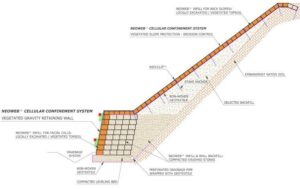
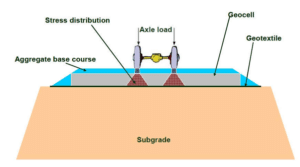
The solution is scientifically proven to reduce erosion by up to 70–80% under heavy rainfall, offer geocell slope protection and reinforce subgrade for roads.
Additionally, unlike unreinforced methods, the cells can be installed in flood-prone areas without major disruption.
They are also sustainable, flexible and adaptable to clay, silt and sandy soils.
Practical Applications for UK Businesses
Sustainable geocell solutions in the UK are finding favour among business infrastructure specialists due to their versatility of use.
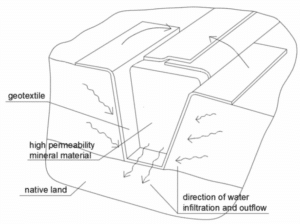
Roads supporting supply chains are enhanced more affordably, embankments protecting industrial parks or rail access are strengthened, and there is improved surface water flood mitigation around warehouses, commercial sites and ports.
Operational continuity is also maintained through coastal and riverbank stabilisation.
Case Studies & Evidence-Based Results
There is significant evidence of the effectiveness of Neoloy Tough Cells installation across the UK.
A road reinforcement project in Southern England saw flood-related closures being reduced by 40-50%.
At an industrial port in Scotland, implementation of the solution during an embankment stabilization project resulted in slope stability being improved with a safety factor increase of 1.4.
A pilot project in the UK also reported a 30% decrease in transport disruptions due to geocell slope stabilization, while one study indicated there was a 70-80% reduction in soil erosion after geocell installation.
A particularly notable example is the intervention made at a bridge access road in England.
PRS Geo-Technologies, which utilised its Neoloy Tough-Cells for the project, recorded a 50% cost saving and 30% reduction in construction time.
Planning & Implementation Considerations
Businesses and municipal authorities need to consider the following when integrating Neoloy (geocells) for UK conditions:
Site assessment and flood risk mapping using Environment Agency flood maps.
Soil and slope analysis tailored to the UK.
Installation steps for roads, embankments and drainage areas.
Maintenance and long-term monitoring to ensure resilience.
It is important to note that when geocells are installed correctly, road and embankment lifespan can be extended by as much as 10-15 years.
Conclusion/h2>
It is apparent that sustainable geocell solutions in the UK will continue to gain traction.
Businesses and planners will increasingly need to assess flood vulnerability as climate concerns rise.
It stands to reason that a solution that provides long-term, cost-effective resilience while reducing operational disruption, maintenance costs and environmental impact is bound to attract many new followers.