
Coastal Erosion and Flood Risks in the UK
Coastal erosion and flooding are ever-present threats in the UK.
Since 1900, sea levels have risen by 16cm and are projected to increase by another 30-100cm in the next 75 years.
Rising sea levels and storm surges threaten both urban and rural coastal areas.
Currently 2.4 million properties in the UK are at risk of coastal flooding alone.
Given that storm surge events are already costing UK businesses and councils £1–2 billion a year, there is a crucial need to reinforce flood defences to safeguard trade, ports and municipalities.
Challenges Faced by UK Businesses and Authorities
The task will not be easy.
In some parts of England, coastal erosion is leading to the loss of 2m of coastline per year. At the same time rundown flood defences are becoming commonplace.
The Environment Agency reports that in the east of the country nearly one in 11 defences are deemed “poor” or “very poor”.
From a business perspective this is extremely concerning.
Each year ports handle £70 billion in freight and coastal flooding can cause multi-million-pound disruptions.
Additionally, maintenance and repair costs are high, the safety of communities and industrial sites is compromised, and compliance with environmental and planning regulations is severely impacted.
Limitations of Traditional Coastal Protection Methods
One of the problems the UK is facing is that unreinforced embankment reinforcement may be insufficient.
Traditional coastal defenses fail in 30–50% of storm surge events within 5–10 years.
Annual maintenance of traditional embankments is also expensive: councils spend £300–500 million annually on these measures.
What should also be considered is that unreinforced coastal embankment stabilization UK solutions are often made of concrete or filled with rock, making them inflexible.
Furthermore, temporary solutions such as sandbags and gabions often fail under extreme storms.
Geocell Technology: How It Works
Flood-resilient coastal infrastructure UK-specific solutions are coming to the fore, however.
A standout is geocell technology – a honeycomb-like structure that confines soil and distributes load, reduces erosion, stabilises slopes and reinforces embankments.
These three-dimensional cells are expanded on site and filled with aggregate, soil or sand.
The nano-polymeric alloys have been found to reduce erosion by 70-80% in coastal and slope applications.
Installing them also increases the embankment stability factor by 1.3–1.5 times compared to unreinforced soil.
Importantly, geocell for erosion control UK measures are flexible, sustainable and adaptable to country coastal soils.
Practical Applications for UK Coastal Infrastructure
Geocell slope protection UK solutions have a variety of uses.
These include coastal embankments that protect towns, industrial zones and ports, stabilization of dunes and shoreline slopes, and integration with flood defenses and drainage systems.
Notably, case studies show maintenance frequency is reduced by by 25–35% after geocell reinforcement.

Case Studies and Evidence-Based Results
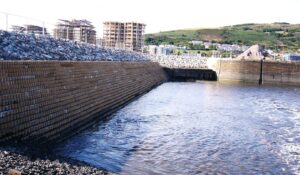
A great example of a sustainable coastal reinforcement UK solution can be found in Swansea, Wales.
PRS Geo Technologies worked with the Welsh Development Agency to create a sea wall to protect the coastal shoreline of a new residential neighbourhood under construction.
Gabion solutions had been tried and failed while construction was time-consuming, wire netting broke and a waterproof barrier could not be created.
Walls also required large amounts of concrete and a huge footer foundation underwater.
However, PRS used its Neoloy Tough-Cells geocells to build the large retention wall.
Neoloy walls filled with concrete were constructed in the Fastest and more easily with the highest resistance to static forces, ground movement, wave action and corrosion from the sea.
Planning and implementation considerations
Effective geocell installation can extend embankment lifespan by 10–15 years under UK storm conditions.
However, it is important to consider the following to integrate geocells effectively:
- Coastal site assessment and flood risk mapping.
- Soil and tidal analysis for selecting the appropriate geocell type.
- Step-by-step installation for embankments, levees and dune stabilisation.
- Maintenance and monitoring for long-term protection.
Building Flood-Resilient Coastal Infrastructure
There is a range of proven benefits that go with geocell and Neoloy UK coastal protection
Neoloy technology offers durability, cost-effectiveness and environmentally sustainable solutions.
Add to this that it reduces erosion, maintenance costs and operational disruptions and it makes perfect sense why more engineers and town planners are turning to geocells.
With there still being so much concern around the effects of climate change on the UK’s oceans and coastlines, adoption of this solution has become a question of when, not if.
In areas where coastal zones are especially vulnerable, the need for this type of intervention is even greater.