
Why Geocell Material Matters for Long-Term Performance 

Geocells may look similar once expanded on site, but their long-term performance depends heavily on the material used to manufacture the cell walls. 

In load support and soil stabilization applications, the geocell must maintain geometry, stiffness, tensile resistance, and durability under real project conditions. Comparing NPA and HDPE geocells should focus on measurable engineering properties and the project’s required performance level. 

The Key Difference: Material Behavior Over Time

Both NPA and HDPE geocells create a 3D cellular confinement system. At first glance, they may look similar. The real difference is how the cell wall material behaves over time under load.

When vertical loads are applied, the infill pushes laterally against the cell walls. The geocell must resist that pressure to maintain confinement, compaction, and structural contribution. If the cell walls stretch, creep, or lose stiffness over time, the system can gradually lose performance.

This raises an important engineering question:

How long will the geocell maintain its shape, stiffness, and confinement before permanent deformation begins to affect the structure?

Plastic materials can deform over time, especially under repeated loading, high temperatures, or long-term stress. That is why material properties such as creep resistance, elastic stiffness, tensile strength, and long-term deformation behavior are critical when comparing NPA and HDPE geocells.

Engineering takeaway: do not compare geocells by appearance alone. Compare the material properties that determine design-life performance. The key question is not only whether the geocell works on day one, but whether it continues to provide confinement and structural support throughout the project’s required service life.

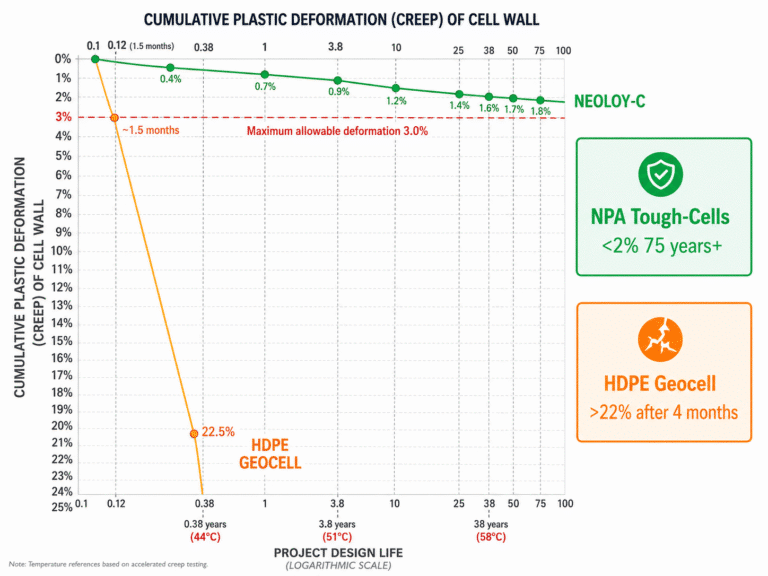
NPA vs HDPE Geocells

Note: The chart compares long-term cell-wall creep against accepted deformation limits for geocell performance. While the chart marks 3% as the maximum allowable deformation threshold, stricter guidance for reinforcement geosynthetics references below 2% accumulated deformation to maintain confinement, compaction, and long-term structural contribution.

What Engineers Should Compare

Performance Area Why It Matters
Elastic stiffness
Supports confinement and load distribution under repeated or dynamic loading.
Resistance to permanent deformation / creep
Preserve cell geometry and prevent loss of confinement over the design life.
Tensile strength
The cell wall resist hoop stresses generated by confined infill.
Seam and connection strength
Keeps the cellular structure intact under load and installation stresses.
Environmental durability
Protects polymer performance during exposure, UV, oxidation, temperature changes, and service life.
Validated improvement factors
Supports reliable design assumptions for pavement and load support applications.

When to Choose Each Material

Basic applications

HDPE Soft-Cells

  • The application is simple slope protection, erosion control, retaining walls, or low-load support.
  • The design life is shorter or the structural contribution is limited.
  • The project does not require high stiffness, creep resistance, or heavy-duty load support.

Project Insight: Why Material Selection Matters

A railway embankment project describes HDPE geocells being replaced after persistent settlement and frequent track maintenance. Neoloy® Tough-Cells were used for long-term stabilization over soft clay, with reported benefits including reduced maintenance, faster construction, restored rail speed, and use of local sand. 

Request Project Evaluation

PRS can evaluate your load requirements, soil conditions, design life, infill options, and performance goals to recommend whether NPA or HDPE geocells are suitable for your project