
Heavy Rainfall Challenges in South Africa
Certain regions in South Africa experience high levels of seasonal rainfall that take a heavy toll on infrastructure, roads and industrial areas.
For engineers, municipal planners, road contractors, sustainability officers and other infrastructure professionals these weather conditions can prove extremely problematic.
Slope instability in provinces like KwaZulu-Natal, which receives 1,000–1,500 mm of rainfall per year, is rife.
Figures from the CSIR also indicate that 30-40% of rural roads experience erosion-related damage annually.
These rural and mountainous roads are especially vulnerable to washouts and embankment collapse.
For businesses and municipalities, operational and maintenance costs can be astronomical.
Challenges Faced by South African Businesses and Municipalities
There is no question the statistics paint a troubling picture, particularly in a nation where economic pressures are a constant reality.
Road maintenance in high-rainfall zones can increase costs by 20–35% while landslides in KwaZulu-Natal and the Eastern Cape cause hundreds of millions in damage annually.
Heavy rains invariably take a huge toll, affecting business logistics and supply chains and causing government costs for highway and mining road maintenance to skyrocket.
It stands to reason that worker safety and the lives of residents in these high-risk zones are also severely compromised.
Furthermore, compliance with environmental regulations in respect of soil conservation becomes more difficult.
Limitations of Unreinforced Erosion Control Methods
Unreinforced methods for hillside and embankment reinforcement in South Africa are often insufficient for country conditions.
Studies have shown that traditional slope reinforcement methods fail in 30–50% of high-rainfall events.
Among the reasons are that earth embankments and compacted soil often fail under heavy rain and temporary solutions like sandbags and soil bags do not provide long-term resilience.
The slope stabilization South Africa conundrum thus requires different answers.
Geocell Technology: How It Works
One of these solutions is Neoloy Tough cells geocell technology.
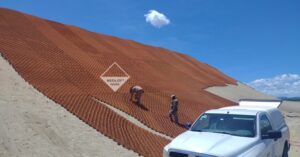
This takes the form of a honeycomb-like nano-polymeric alloys structure that confines soil and distributes load, reduces erosion, stabilizes slopes and reinforces embankments.
These three-dimensional cells are expanded on site and filled with aggregate, soil or sand.
Practical Applications for South African Infrastructure
Geocells have myriad uses and applications for South Africa’s infrastructure professionals.
They are perfectly suited to stabilizing roads and highways prone to washouts in heavy rainfall zones as well as mining haul roads and industrial embankments in need of load-bearing reinforcement.
Within the sustainable geocell infrastructure South African context, their capabilities as a hillside stabiliser in rural developments and agricultural areas are first-class.
They are flexible, sustainable and adaptable to clay, sandy or silty soils.
Case Studies and Evidence-Based Results
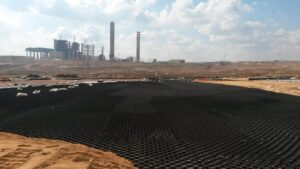
PRS Geo Technologies, making use of its Neoloy Tough-Cell geocells, assisted South African power utility Eskom in protecting a coal ash landfill site near Pretoria.
Eskom designed a durable composite liner system to ensure the safety of the surrounding groundwater.
This multi-tiered composite liner system for the fly ash dump consisted of seven layers, including a 100mm sand layer for the geocells.
The strongest tensile strength cellular confinement properties of the technology prevent movement of the sand layer during continuous trafficking of heavy vehicles on the ash dump’s access road.
The solution proved significantly cost-effective due to a reduction in construction and maintenance costs.
It was also able to accommodate subgrade movement, thereby preventing cracking.
Importantly, there was the lowest environmental impact since inert polymeric alloy is resistant to chemicals, liquids, and climatic factors.
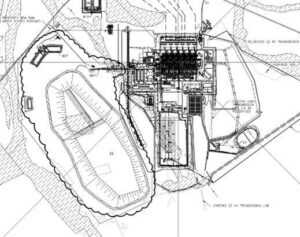
Plan of the Facility and Coal Ash Landfill
Planning & Implementation Considerations
The key to integrating Neoloy Tough cells technology effectively lies in ensuring guidelines are followed as closely as possible. These include:
- Conducting site-specific rainfall and soil analysis.
- Selecting the appropriate geocell type and specifications for local soil conditions.
- Step-by-step installation for slopes, embankments and drainage areas.
- Maintenance planning for long-term erosion control and slope stability.
Building Resilient Infrastructure in South Africa
The value of geocells for South African businesses, state-owned enterprises and municipalities is immense, particularly those falling in heavy rainfall zones.
They have been scientifically proven to be cost-effective, durable and sustainable solutions.
Not only in South Africa but globally this technology has been found to reduce operational disruptions, infrastructure damage and maintenance costs.
Since heavy rainfall is a given in many parts of the country, it becomes imperative for businesses and local government institutions to explore the use of Neoloy Tough cells to mitigate the effects of erosion and slope instability.