
Need for Ground Stabilization Solutions
For civil engineers, project managers and municipal planners the potential impact of weak soil stabilization is a constant worry.
Weak soil severely compromises the foundation of any building.
As Hanif Kara, a professor at the Harvard Graduate School of Design, points out, soils are not immune to failure themselves.
However, the advent of soil improvement techniques like Neoloy green 3D mechanical soil stabilisation technology is changing the building landscape like never before.
Who Requires Ground Stabilization Solutions?
There is huge need for effective ground stabilization solutions among building design and construction professionals.
The demands of these industries require technologies that not only optimise infrastructure performance but are also cost-effective.
For a geo/civil engineer or city planner working to a budget, delays and additional expenses are not an option.
It is for this reason that soil reinforcement methods are coming to such prominence.
Common Challenges of Weak Soils in Construction
Professionals encounter a range of weak soil challenges.
The composition of earth can vary considerably while wet soil is unfit for building.
Some soil may not even be able to bear the load of a foundation.
PRS Geo-Technologies has found that soft clay and silt soils can experience up to 20–50% settlement under load if not stabilized.
Unfortunately, the onus then falls on the construction company, engineering firm or municipality to carry the extra cost, which can sometimes be 10-25% higher.
This again highlights the importance of improving soil bearing capacity.
Overview of Soil Stabilization Methods
While soil reinforcement methods are not new, unreinforced methods have often fallen short.
Mechanical compaction, chemical stabilization and geosynthetics carry long installation times, high costs and are largely site-specific.
This has necessitated a major rethink around soil improvement techniques.
The result has been the development of peoven and unique technologies like PRS’s Neoloy Tough Cells.
These are the only geocells scientifically proven to provide the highest tensile strength, dynamic modulus, elastic stiffness and resistance to plastic deformation.
Remarkably, Neoloy geocell reinforcement can increase the bearing capacity of sandy soil by 38-73%.
Neoloy Tough Cells
Since 2004, PRS has led a R&D initiative to develop this Novel Polymer Alloy.
The geocell soil stabilization technology has been validated through hundreds of tests, studies and real-world applications by researchers in Japan, Germany and the US.
The cells have also been certified by global standards bodies like ISO, ASTM and the US Federal Highway Administration.
They can be easily installed, are adaptable to weak soils, are cost-effective and can withstand loads exceeding 100 tons/m².
Furthermore, with geocell reinforced foundations, lateral soil movement can be reduced by up to 90%.
Foundation Soil Improvement in the Real World
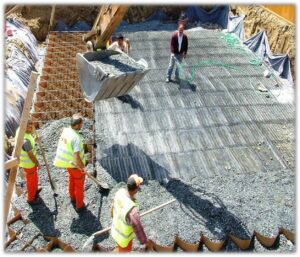
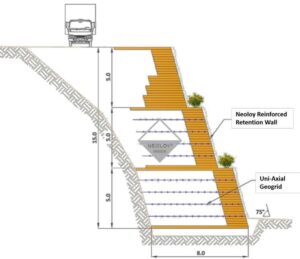
There are countless examples of how geocells for weak soils are successfully utilized.
At a luxury complex in Turkey, a situation arose where a 15m high retaining wall of sufficient strength and durability was required to support a road and car park above.
Traditional solutions using segmental retaining walls entailed complicated site logistics.
The Neoloy geocell system not only provided the required engineering strength but also reinforcement to withstand extreme seismic motions.
In Poland, an upgrade of the national express road included a service road for heavy construction vehicles where stabilizing weak soils was required.
Neoloy Tough Cells were deployed and the reinforced road could support the traffic of heavy vehicles.
In all cases settlement is reduced by 40%, bearing capacity improvement is double that of unreinforced soil, and maintenance costs are reduced by 30-40% over 10 years.
The key to these positive outcomes has been PRS’s unwavering commitment to providing customers professional guidance and support.
Steps to Implement Effective Soil Stabilization
There are several steps to follow when choosing soil stabilization methods for construction.
Professionals should start with a site assessment and soil analysis before deciding on the correct Neoloy Tough Cell configuration.
It should be remembered that ground stabilization solutions should always follow installation best practice.
The final two steps in the process are compaction and finishing techniques and performance monitoring.
Impressively, installing the Tough-Cell solution can be up to 50% faster than traditional methods.
Choosing the Right Soil Stabilization Solution for Your Project
When assessing soil reinforcement methods, professionals should always evaluate the soil type and load requirements and compare cost, durability and maintenance.
Improving soil strength when encountering weak soils requires innovative solutions and professionals are advised to consider Neoloy Tough Cells for their next project.
Durable Infrastructure with PRS Neoloy Tough Cells
Geocell soil stabilization is what engineers, builders and town planners have been waiting for.
The hours wasted using traditional methods for stabilizing weak soils to ensure infrastructural safety and longevity will be no more thanks to Neoloy Tough Cells.
Get in touch with PRS for tailored soil stabilization solutions that already have proven successful in more than 10,000 projects globally.